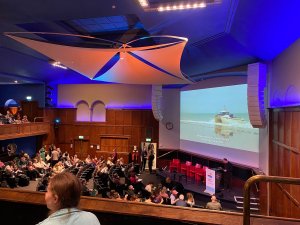
The largest ocean conference of its kind in the UK, Coastal Futures brings together people from across estuarine, coastal and marine spaces to explore the policies, partnerships, and innovations needed to deliver a thriving ocean for all.
Our Head of SciPol, Charlotte Browne, Senior Research and Innovation Lead Chantal Lyons and Fisheries Project Lead Lia ní Aodha were there to soak in the atmosphere, and have shared their reflections.
From Charlotte and Chantal:
Walking across Hyde Park to the Coastal Futures conference on a misty but sunlit Wednesday morning, we paused to take in this pocket of nature at the heart of London. It was a timely reminder of why we gather at events like this. Though we spend the day indoors, away from the elements, we are here because of a shared connection to our natural world – and a determination to turn ambition for the marine environment into lasting change.
That challenge sat at the centre of the conference. Day 1 discussions spanned shared stewardship, coastal resilience, and ocean planning, but one message cut through: progress depends on active collaboration. Not collaboration as a buzzword or funding requirement, but as a deliberate practice – making time and space for shared goals, and recognising the different strengths partners bring. Yet an uncomfortable truth emerged. Even strong, well-established networks can become siloed. Collaboration, like any system, needs constant attention if it’s to deliver real outcomes.
The urgency could not be clearer. Following the Government’s warning that ecosystem collapse threatens national security, climate impacts continue to play out along our coasts – homes lost to erosion, communities rebuilding after flooding. While environmental change can appear gradual at a global scale, for coastal communities it is often abrupt, personal, and devastating.
For everyone working in the communications space, the lesson is clear. We are getting better at describing the problem, but too often communication remains reactive – arriving late, focused on managing fallout rather than enabling foresight. The conference showcased some shining examples of where the real opportunities lie: helping communities and decision-makers understand what lies ahead, translating complex evidence into clear, relevant insight, and creating space for meaningful engagement before crisis hits.
Done well, communication becomes not an afterthought but an enabler of action and a nurturer of agency for both individuals and communities. When rooted in the power of the local, it can reach and resonate with those at the heart of the issue. Using stories and messengers that feel familiar, leading with empathy, and understanding values are not “nice to haves” – they are essential infrastructure for change. Building connected networks that share learning, rather than operate in isolation, is how we move beyond pilots and pathfinders towards approaches that can be mainstreamed, scaled, and sustained.
In amongst the many discussions centred on collaborating across sectors and geographies, a note of caution came from an early career researcher, concerned that we are falling into the trap of racing to develop as much of the marine space as possible. It was a clear reminder that consideration for the needs of the environment must be part of the bedrock of discussions about our marine spaces. Whether for people or for nature, our collective goalposts must aim far higher than to “do the least worst”.
From Lia:
Our problem is not data, it’s not knowledge, it’s politics. This is the line that circled in my head throughout the morning sessions on day two of Coastal Futures 2026. Politics about whose knowledge counts, how people are engaged, and whether decisions actually turn ambition into action when it comes to the sea. Because ambition itself, of course, is political.
Coastal Futures brought together people from across estuarine, coastal and marine spaces to explore the policies, partnerships and innovations needed to deliver a thriving ocean for all. The central question running through the event was: how do we move beyond ambition to action? On day two, the focus homed in on Action and Accountability – how we make good policy decisions, and crucially, how we make sure those decisions are followed through on the ground (or on the water).
Panellists outlined the importance of clear problem identification, evidence, adequate resources, meaningful engagement, and delivery plans… but perhaps more than that, having the leadership to see change through in the long term. There was broad agreement that, particularly in the marine environment, we will never have perfect knowledge. Dynamic ecosystems demand adaptability. Uncertainty cannot be an excuse for inaction when the need to act is clear. Responsible decision-making means grappling not just with knowledge gaps, but with values gaps too. Ultimately the messy policy making process comes down to values, to the political, and to whose voices are heard (or aren’t).
Bringing fishing firmly into this conversation, Alistair Carmichael MP, Co-Chair of the All Party Parliamentary Group (APPG) on Fisheries, was clear: for fishing communities, the time to act is also now. Discussing the Action Plan for the industry being developed by the cross-party group, he outlined the reality that fishing isn’t just an environmental issue or a social one. It’s both. Stocks, habitats, fleets, businesses, crews, families and communities are all interconnected. Going beyond one or the other, a sustainable coastal future will depend on recognising this and ensuring that efforts to conserve our environment go hand in hand with protecting diverse fishing livelihoods – with fishing communities (their knowledge, their reality, their ambition) fully part of the conversation.
The three of us came away from these two days of intense discussions with a renewed determination to embody Mindfully Wired’s mission: centering people and planet in everything we do. Turning ambition into action will certainly not be simple, but it has to start there.